
It all started when I went to bed one May night with two perfectly normal, working hands.
Nothing unusual. Nothing exciting. Nothing to report.
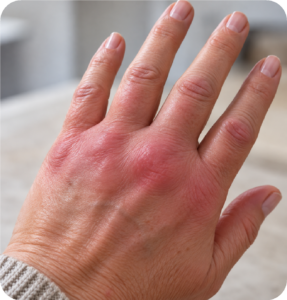
Then I woke up the next morning and thought: “What the hell has happened to my left hand?”
It had swollen up like a bloody melon. It was so stiff, painful and seriously swollen, and I knew straight away that something wasn’t right. I could hardly move it, and if I tried, it literally felt like my hand was on fire.
ALL THINGS MEDICAL
So I managed to get an appointment with my GP that day. He thought it was cellulitis and prescribed antibiotics.
Except they didn’t work.
So I went back to my GP, who was concerned enough to send me down to my local hospital – and this is where the fun started.
I had blood tests galore, X-rays of my hand, and I even saw an orthopaedic hand surgeon.
When the test results came back, the general consensus was that it could be rheumatoid-related, and I was advised to see a rheumatologist.
THE DIAGNOSIS
Fortunately for me, I had private medical insurance, so I was able to see a rheumatologist fairly quickly.
He looked at my hospital X-rays and the findings from my investigations, but wanted to carry out more tests before giving me a formal diagnosis.
So, more tests. Another X-ray, an ultrasound and lots more blood tests.
Eventually, I got my diagnosis. CPPD arthritis and osteoarthritis.
I’d heard of osteoarthritis. I should imagine most people have, and most people know somebody who’s got it.
But CPPD arthritis?
“What the devil’s that?” I thought to myself.
My rheumatologist explained that CPPD arthritis is caused by something called calcium pyrophosphate crystals, which build up in and around the joints and can cause inflammation, pain and swelling.
Okay, I thought. That sounds pretty nasty. I don’t like the sound of that.
But I still didn’t really understand what it meant for me, what was going to happen, or what I could actually do about it.
So, like most people, I went home and did what we do when we’re faced with something medical, we’ve never heard of or don’t understand.
I asked Dr Google.
And that’s when I discovered that CPPD arthritis seemed to have been written especially for people who already had a medical degree and were rheumatologists, but nothing really for the everyday person.
THOSE PESKY CRYSTALS

There was information galore about something called pseudogout. It turns out that pseudogout is an older term for CPPD arthritis. But because it’s got the word gout in it, people naturally assume that CPPD arthritis is a form of gout.
It isn’t.
CPPD arthritis is a form of arthritis in its own right, caused by calcium pyrophosphate crystals. Gout is a different type of arthritis, caused by urate crystals. So, although both conditions involve crystals and can cause some very painful, swollen joints, they are not the same condition.
And I think that’s one of the reasons CPPD arthritis can be so confusing when you first start looking into it. I also discovered that, although gout is a different condition, there are medications that can help manage it, and diet and lifestyle can also play a role in helping to control it.
But what I found particularly frustrating about CPPD arthritis was that there is currently no cure.
There is no established treatment that gets rid of the crystals or stops them from forming.
“Great,” I thought. “That’s something really nice to look forward to.”
INSPIRATION BORN OUT OF FRUSTRATION (WITH A BIT OF DESPERATION THROWN IN)
So, the more I looked into it, the more I thought, “Hang on a minute.” I’ve got a diagnosis, I’m struggling to understand it, and I have a reasonable understanding of how the human body works. So, what about everybody else? Because surely I wasn’t the only person thinking: “Right, I’ve got this CPPD arthritis, so tell me what this thing does, how it forms and what I can do to help myself.”
And that’s when I thought: “Right, I need to get my head around this.”
I’m the kind of person who needs to write things down to make sense of things. So I started putting my thoughts on paper and, gradually, those notes started to turn into something that looked suspiciously like a workbook.
And I thought to myself: “I bet this would be really useful for people out there who are struggling, like I was, to actually understand what CPPD arthritis is in really easy-to-understand language.” And that’s how the workbook came about.
If you’ve never heard of CPPD arthritis, perhaps you’ve just had your “Ooh, what’s that?” moment.
And if you’ve been diagnosed with it, or you know someone who has, I genuinely hope my workbook reaches you and makes a very confusing subject feel a lot less scary and a lot more understandable and relatable.
CPPD Arthritis (Pseudogout) Made Simple Workbook
You can find my workbook here on Amazon.